Your Next.js app is TypeScript. Your content platform might not be. That is fine when the API boundary is typed, documented, and stable. Pick where complexity lives: inside your repo (code-first) or behind a clean API (SDK-first).
What TypeScript CMS means
Search results mix three layers:
- TypeScript-native CMS - server, config, and plugins authored in TypeScript. Payload is the usual reference.
- Typed integration - REST or GraphQL plus a JS/TS SDK so your frontend does not treat content as
any. - Shared types in one repo - monorepo setups where collection schemas flow into frontend components. Strongest with code-first CMS.
ElmapiCMS is Laravel + React with a TypeScript/JavaScript SDK for the content API. It does not claim to be written in TypeScript like Payload. It competes on typed client DX, multi-project self-hosting, and $74 one-time payment.
How we compared
- Where TypeScript lives - CMS core vs SDK/client vs both.
- Headless API - REST, GraphQL, or query languages for App Router fetch patterns.
- Editor vs developer split - GUI content modeling vs code-first config.
- Multi-project fit - one install with isolation vs one app per site.
- Cost shape - MIT + hosting, one-time license, or SaaS seats.
1. ElmapiCMS

ElmapiCMS is a self-hosted headless CMS on Laravel 13 and React. It needs PHP 8.4+. It is not a TypeScript-native backend. For TypeScript teams, the pitch is a documented REST Content API, a JavaScript/TypeScript SDK, and a GUI for editors so you do not redeploy the CMS when marketing adds a field.
Unlimited isolated projects on one install is the agency angle. Many Payload setups use N Node deployments for the same job.
What ships in 4.0
- Draft and publish, content versioning, and locales
- Asset library with WebP images, crop tools, and optional S3 direct upload
- Built-in AI tools and an official MCP server for Cursor and Claude Code
- Authentication for frontend (signup, sign-in, refresh)
- Frontend templates for Next.js, Nuxt, and Astro
- Webhooks, JS SDK, and project API tokens
Why TypeScript frontends use it
- Typed client layer - fetch collections and entries from Next.js with SDK helpers. See developer docs.
- Multi-project isolation - per-project API keys and content without a custom tenancy layer.
- $74 one-time payment - predictable cost when you run many typed sites.
- PHP hosting economics - lighter than stacking many Node CMS instances per client.
Pricing: $74 one-time payment. See pricing · Live demo
Best for: TypeScript frontends that want a standalone admin, REST + SDK integration, and multi-client hosting.
2. NomaCMS
NomaCMS is a managed, AI-native headless CMS. You get structured content, a REST API, a JavaScript SDK, and AI for writing, translation, and editing. Ship to Next.js, Nuxt, Astro, or other TypeScript stacks without running your own CMS server. Connect Cursor, Claude Code, or other MCP-compatible tools with the Noma MCP server.
Why consider NomaCMS
- Managed cloud with global CDN for assets and no server ops on your side
- AI assistant, inline field actions, and one-click entry translation
- REST API and SDK with predictable shapes for typed frontends
- MCP server for AI editors (
npx -y @nomacms/mcp-server) - Project auth, webhooks, locales, and team workspaces on paid plans
Pricing: Plans start at $15 per month after a 7-day free trial. See nomacms.com · Start free trial
Best for: TypeScript teams that want hosted delivery and AI-first workflows, not a self-hosted install.
3. Payload CMS

Payload is the default answer when someone asks for a TypeScript headless CMS in the strict sense. The product is TypeScript end to end. You define collections in code, extend the admin with React components, and keep types close to your Next.js or Remix app.
TypeScript strengths
- Native TS config - schemas, access control, and hooks are first-class TypeScript.
- Shared mental model - same language on CMS and frontend teams.
- Deep customization - when CMS as code is a feature, not a burden.
Tradeoffs
- Ops and hosting - Node deployment. Multiple client sites often mean multiple Payload apps unless you build multi-tenancy yourself.
- Editor-first teams - non-developers depend on your schema changes and deploy cadence.
Evaluating a move away from Payload? Start with Payload alternatives.
Pricing: Free (MIT). Best for: TypeScript monorepos where engineers own the content model.
4. Directus
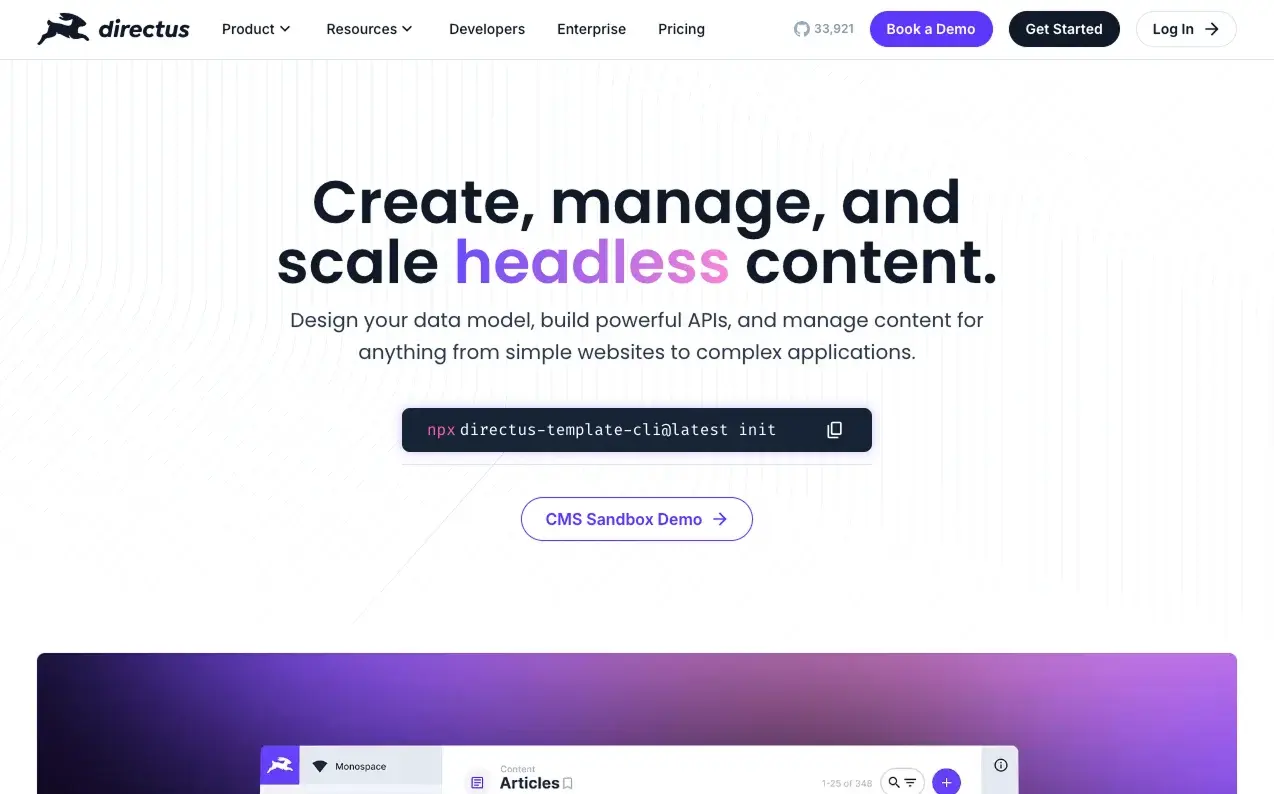
Directus sits on your SQL database and exposes REST and GraphQL. The core is not a TypeScript CMS in the Payload sense, but the official SDK and TypeScript typings are a real part of the story.
Pricing: Free (GPL). Cloud options exist. Best for: data-heavy products, custom SQL, and typed client calls without merging CMS and app repos.
5. Strapi
Strapi is JavaScript/Node-first rather than TypeScript-native. It sits in the same ecosystem as many TypeScript frontends. Plugins, webhooks, and REST/GraphQL fit Next.js workflows. Typed clients often come from community generators or hand-rolled interfaces over OpenAPI.
Plan for RAM. Strapi often wants 1GB or more, and each project usually needs its own install.
Pricing: Free (MIT). Best for: Node teams that want a large plugin market and optional GraphQL.
6. Sanity
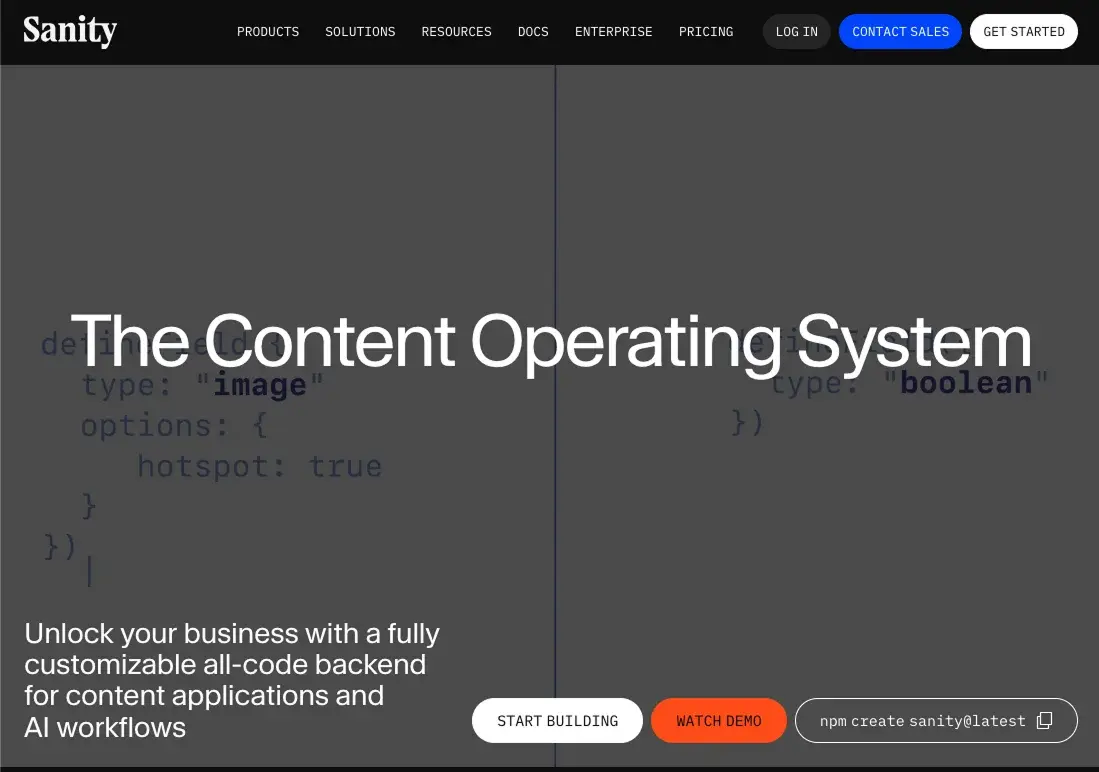
Sanity is a managed content platform. Schema is defined in JavaScript/TypeScript. Client libraries work well with typed React frontends. GROQ and structured content pair with React Server Components when you accept SaaS pricing and vendor-hosted data.
Pricing: Free tier available. Paid plans often start around $15/month per user. Best for: cloud-first teams that prioritize editor UX and typed clients over self-hosting.
Comparison table
| Factor | ElmapiCMS | NomaCMS | Payload | Directus | Strapi | Sanity |
|---|---|---|---|---|---|---|
| CMS core in TypeScript | No (Laravel + React) | Managed cloud | Yes | Partial / TS SDK | JS (TS in ecosystem) | Schema in TS/JS |
| Typed JS/TS client SDK | REST + SDK | REST + SDK | Local types | Official SDK | REST/GraphQL + patterns | Typed client |
| Content modeling | GUI admin | GUI admin | Code-first | DB + UI | GUI + extensions | Schema as code |
| Multi-project | Built-in | Projects | Per app / DIY | DIY | Per install | Spaces |
| Hosting | Self-host | Managed | Self-host / cloud | Self-host / cloud | Self-host / cloud | SaaS |
| Software cost | $74 once | From $15/mo | MIT | GPL / cloud | MIT | SaaS |
| Best for | TS frontend + multi-project | Managed AI + SDK | TS monorepo CMS | SQL + SDK types | JS stack CMS | Managed typed content |
FAQ
What is the best CMS for TypeScript?
It depends on where TypeScript must live. ElmapiCMS fits TypeScript frontends that want a REST API, JS/TS SDK, and multi-project self-hosting. NomaCMS fits managed, AI-native cloud delivery with an SDK. Payload is the clearest TypeScript-native CMS when the CMS itself must be code-first TypeScript. Directus, Strapi, and Sanity fit typed clients with different hosting and modeling tradeoffs.
Is a headless CMS with strong TypeScript support always TypeScript-native?
No. Many teams search for headless CMS TypeScript because their app is TypeScript, not because the CMS server must be. Strong TypeScript support often means a typed SDK, OpenAPI clients, and Next.js examples. The backend can be PHP, Node, or managed cloud.
How does ElmapiCMS fit a TypeScript frontend stack?
ElmapiCMS runs on Laravel 13 and React. It is not a TypeScript-native CMS like Payload. For TypeScript teams it offers a REST Content API and a JavaScript/TypeScript SDK so Next.js, Nuxt, and Astro apps fetch content with typed helpers. One self-hosted install supports unlimited isolated projects with one-time licensing.
Payload CMS vs SDK-first headless CMS for TypeScript developers?
Choose Payload when the CMS belongs in your TypeScript monorepo and engineers own the content model in code. Choose an SDK-first CMS such as ElmapiCMS when editors need a standalone admin, you want multi-project isolation on one install, or you prefer PHP self-host economics. See Payload alternatives for a broader vendor list.
How to choose
- Typed frontend + multi-project self-host: ElmapiCMS ($74 once, Laravel 13, JS/TS SDK, templates).
- Managed AI-native cloud with SDK: NomaCMS.
- CMS itself must be TypeScript: Payload.
- SQL database + typed SDK: Directus.
- Node plugin ecosystem: Strapi.
- Managed editor UX + typed clients: Sanity.
Next steps: best self-hosted CMS, Payload alternatives, developer docs, pricing, and live demo.