A PHP headless CMS can be API-native, a classic CMS with an optional API, or a Yii or Laravel site you extend. Pick by API maturity, self-host needs, and whether PHP hosting beats Node for your project count.
Why PHP headless?
- VPS cost - PHP-FPM on a modest box versus a Node process per CMS install.
- Familiar ops - Composer deploys, shared hosting patterns, Laravel pipelines.
- Data control - Content stays on your infrastructure.
- Agency portfolios - One Laravel install with many isolated projects.
- License shape - $74 once versus per-site Pro fees or SaaS seats.
What PHP headless means
- API-native PHP CMS - Collections and REST are the product (ElmapiCMS).
- Laravel CMS + headless mode - Editorial UX first, APIs when enabled (Statamic).
- Traditional PHP CMS + API - Themes and plugins first (October CMS; Craft with GraphQL).
- Node headless CMS - Strapi and Payload. Strong APIs, different runtime.
1. ElmapiCMS

ElmapiCMS is a self-hosted PHP headless CMS on Laravel 13 and React. It needs PHP 8.4+. Delivery is API-first: collections, media, permissions, and a REST Content API for Next.js, Nuxt, Astro, and other frontends.
One install supports unlimited projects. Each project has its own content and API keys. Agencies maintain one system instead of one PHP app per client.
What ships in 4.0
- Draft and publish, content versioning, and locales
- Asset library with WebP images, crop tools, and optional S3 direct upload
- Built-in AI tools and an official MCP server for Cursor and Claude Code
- Authentication for frontend (signup, sign-in, refresh)
- Frontend templates for Next.js, Nuxt, and Astro
- Webhooks, JS SDK, and project API tokens
Pricing: $74 one-time payment. See pricing · Live demo
Best for: Agencies, freelancers, and product teams that want a ready self-hosted PHP headless CMS with multi-project isolation.
2. Statamic
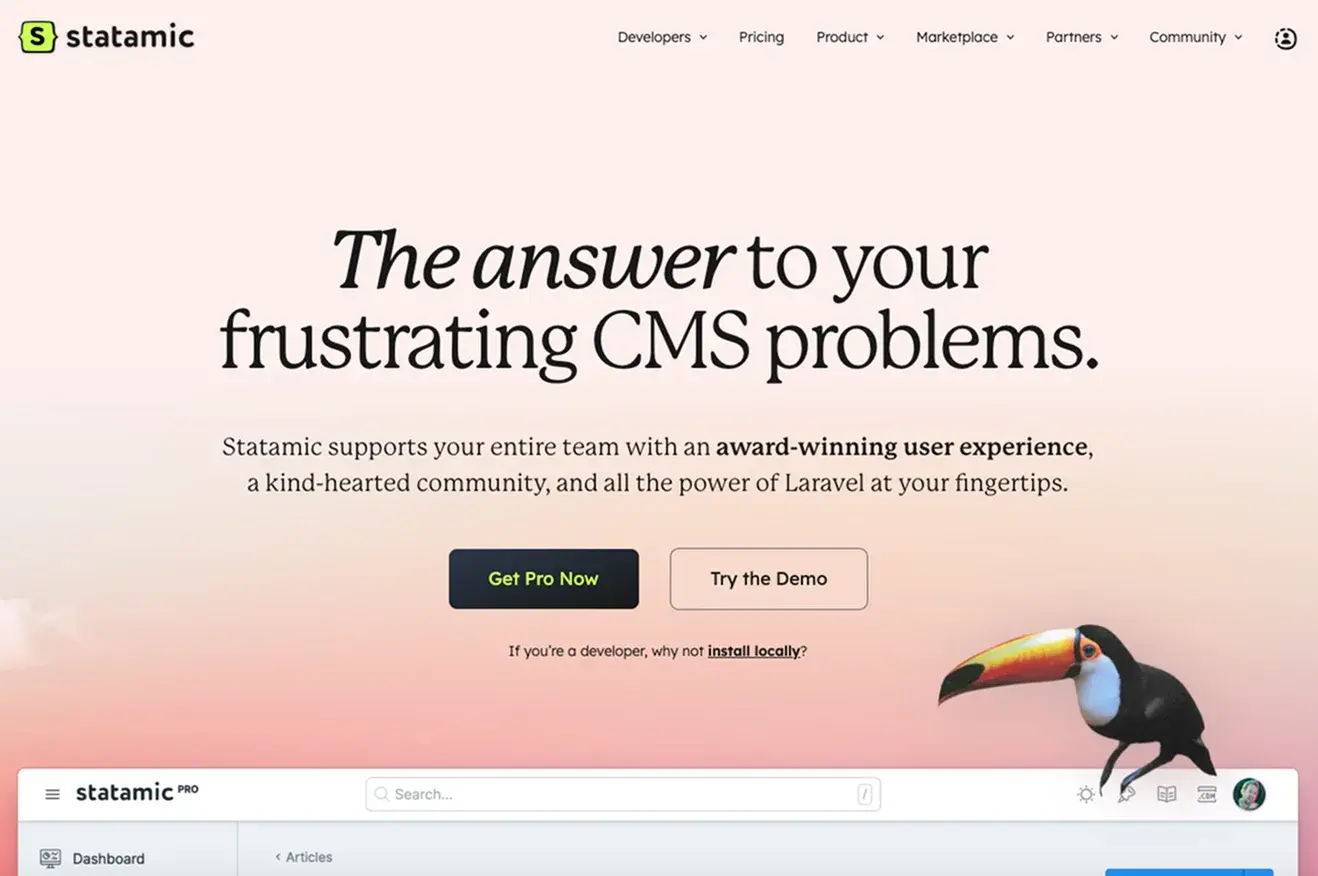
Statamic is a premium Laravel CMS with flat-file or database storage and a strong control panel. Headless mode can expose REST or GraphQL. Workflows stay entry-centric. Pro licensing is usually per site.
Best for: Laravel teams that want Statamic editorial UX first and headless second. Laravel-only comparison: Laravel headless CMS.
3. October CMS
October CMS is a mature Laravel platform with plugins, Twig themes, and multi-site tools. You can expose APIs with plugins or custom routes. The product center is pages and themes, not a documented REST platform for many JavaScript apps.
Best for: Classic Laravel client sites. Weaker default story for pure headless products.
4. Craft CMS
Craft CMS is a polished PHP CMS on Yii, not Laravel. Craft Pro supports GraphQL for headless delivery. Licensing is commercial and usually per site. Hosting is self-managed PHP.
Best for: Content-heavy sites with Craft Pro budget and Yii skills. If your team standardizes on Laravel, compare ElmapiCMS, Statamic, and October first.
5. Strapi and Payload

Strapi and Payload are strong Node and TypeScript headless platforms. They are not PHP. Teams evaluate them when tutorials default to Node or when the repo is already TypeScript end to end.
- Runtime: Persistent Node processes and higher baseline RAM.
- Multi-project: Usually separate installs or custom tenancy.
- When PHP wins: Existing Laravel ops, $74 once, one VPS for many projects. See self-hosted CMS cost.
PHP vs Node ops
| Approach | Typical RAM | 10 client projects |
|---|---|---|
| ElmapiCMS (multi-project PHP) | One PHP-FPM app, often 512MB to 1GB | One install, one update cycle |
| Statamic / October × N sites | Modest PHP per deploy | Often N installs or N licenses |
| Strapi × 10 installs | About 1GB+ RAM per Node instance | 10 processes or one large box |
| Payload × 10 apps | Similar Node profile to Strapi | Repeat deploys and dependency updates |
Free MIT software does not erase hosting multiplication. Deeper tables: best self-hosted CMS.
Comparison table
| Factor | ElmapiCMS | Statamic | October | Craft | Strapi* |
|---|---|---|---|---|---|
| PHP self-host | Yes | Yes | Yes | Yes | No (Node) |
| API-first | Built-in REST | Headless mode | Add-on / custom | GraphQL (Pro) | REST / GraphQL |
| Framework | Laravel 13 | Laravel | Laravel | Yii | N/A |
| Multi-project | Yes | Per-site focus | Multi-site options | Per site | Per install |
| Software cost | $74 once | Free / ~$275/site Pro | Open source | Pro per site | MIT (+ hosting) |
| Best for | API agencies | Premium editorial | Classic Laravel sites | Yii / Craft shops | Node-only teams |
*Strapi is shown for PHP vs Node hosting contrast. It is not a PHP headless CMS.
FAQ
What is the best PHP headless CMS in 2026?
For API-first, self-hosted, multi-project work, ElmapiCMS is built for that on Laravel 13 with REST and $74 once. Statamic is strong when you want a premium Laravel editorial UX with optional headless APIs. October fits traditional Laravel sites. Craft fits Yii-based Pro projects. Compare against Node only if PHP ops are not a requirement.
Can you self-host a PHP headless CMS?
Yes. All options on this page support self-hosting on your VPS or cloud VM. You control backups, regions, and upgrade timing. See self-hosted headless CMS for ElmapiCMS specifics and self-hosted CMS cost for dollar planning.
PHP headless CMS vs Strapi: which uses less RAM?
Single-project differences vary by traffic, but PHP-FPM stacks usually sit on smaller VPS tiers than Node CMS processes. Multi-project agencies feel the gap most: one PHP install versus many Strapi instances. Free MIT licenses do not erase hosting multiplication.
Is Statamic a PHP headless CMS option?
Yes. Enable REST or GraphQL and decouple your frontend. Budget for per-site Pro licensing and a content model oriented around entries rather than multi-project API keys by default.
How to choose
- Ready REST API, self-host, many projects on one install: ElmapiCMS (Laravel 13, $74 once).
- Premium Laravel editorial UX with optional APIs: Statamic.
- Classic Laravel client sites: October CMS.
- Yii shop with Pro budget: Craft CMS.
- TypeScript-only mandate: Strapi or Payload, not PHP.
Next steps: Laravel headless CMS, Laravel CMS overview, best self-hosted CMS, pricing, and live demo.