“Laravel CMS headless” is not one product category. Some tools ship a content API on day one. Others are beautiful page builders where headless is a mode. Still others are admin frameworks where you become the CMS vendor. The right pick depends on REST maturity, Laravel 13 fit, multi-project needs, and whether $74 one-time payment beats per-site licenses or endless custom code.
Why a Laravel Headless CMS?
Teams that already deploy Laravel apps often want the CMS on the same stack:
- REST API first — predictable JSON for modern frontends, not HTML fragments from themes.
- Shared ops — one PHP runtime, familiar queues, Horizon, and deployment pipelines.
- Hosting economics — modest VPS RAM versus multiple Node CMS processes.
- Multi-project agencies — one install with isolated projects beats N separate CMS deployments.
- License clarity — $74 once vs per-site Pro fees or SaaS seats.
If your search was really “any headless CMS,” Node options win mindshare—but they are not laravel cms headless answers. We cover that mismatch in section 5.
What “Headless” Means on Laravel
In practice you are choosing among:
- API-native CMS — collections, fields, and REST endpoints are the product (ElmapiCMS).
- Traditional CMS + API — editorial UX first; headless is an add-on (Statamic, October with work).
- Custom admin + routes — Filament resources plus hand-rolled API controllers.
All can power a decoupled frontend. They differ in setup time, API ergonomics, multi-project defaults, and who maintains the content model when requirements change.
How We Compared These Options
- REST API readiness — first-class content API vs bolt-on endpoints.
- Laravel version & stack — Laravel 13, PHP hosting, React/Livewire admin choices.
- Multi-project — many clients or brands from one install with isolated API keys.
- Editor experience — non-developer friendly vs developer-only admin.
- Pricing shape — $74 one-time license, per-site licenses, or build cost.
1. ElmapiCMS

ElmapiCMS is a self-hosted headless Laravel CMS built on Laravel 13 with a React admin. It is API-first: collections, fields, media, and permissions exist to feed a REST content API—not to render Twig themes. One installation supports unlimited projects, each with isolated content and API keys. That is the agency-shaped answer to “headless cms laravel” without running a separate Laravel app per client.
Why it fits API-first Laravel teams
- REST API — clean content delivery for Next.js, Nuxt, Astro, mobile.
- Laravel 13 + React — modern PHP backend, TypeScript-friendly admin.
- Multi-project by default — switch projects in one dashboard; separate keys per frontend.
- $74 one-time payment — no per-project CMS subscription.
- Full source — customize models, hooks, and hosting like any Laravel product you own.
Best for
Agencies, freelancers, and product teams who want a ready Laravel headless CMS with multi-project isolation and predictable licensing.
2. Statamic (Headless Mode)
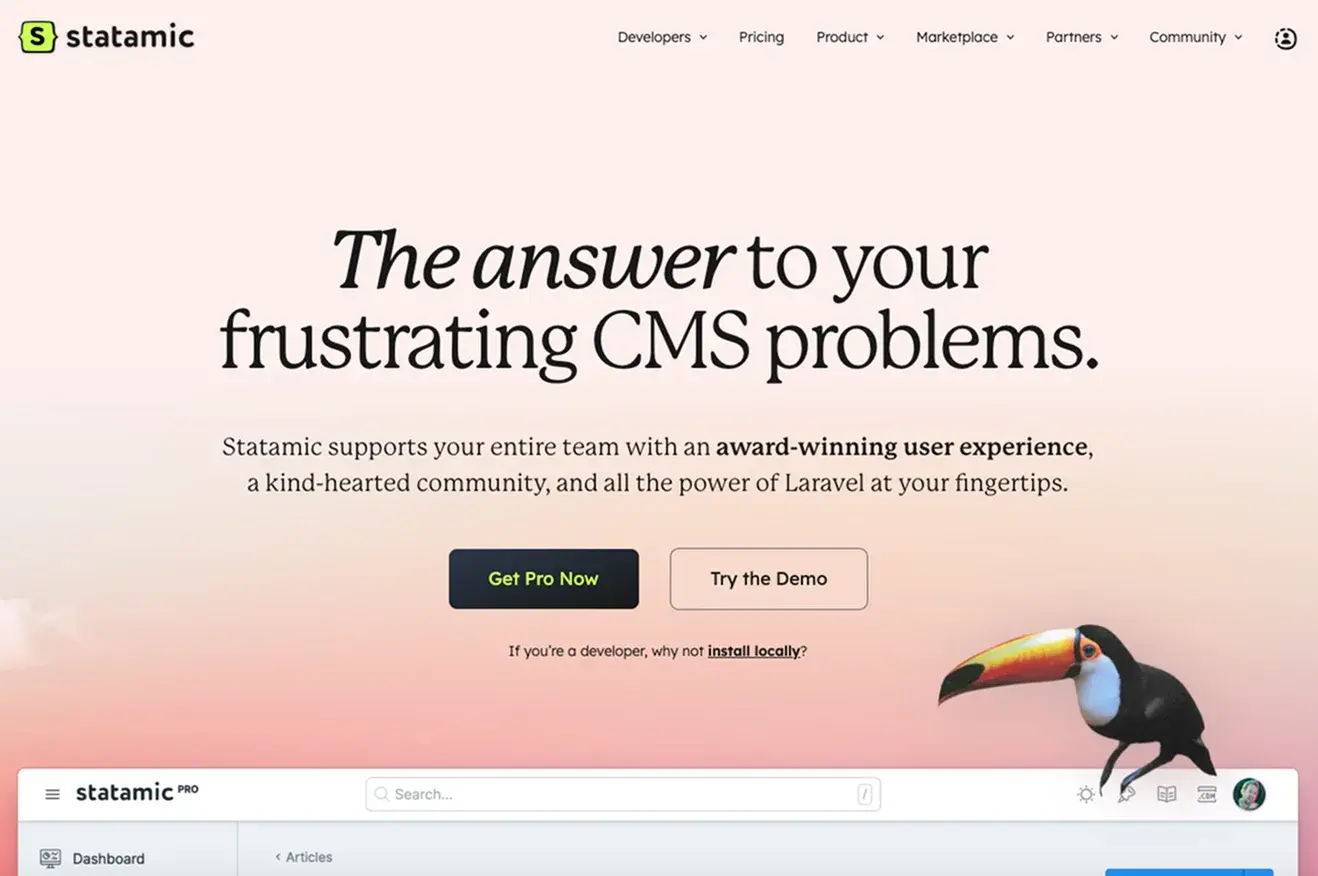
Statamic is a premium Laravel CMS with flat-file or database storage and an exceptional control panel. In headless mode, Statamic exposes REST or GraphQL so your frontend is decoupled—while editorial workflows still feel like a classic CMS (entries, structures, Antlers when you need server rendering).
- API: REST/GraphQL when enabled—not the default “install and fetch JSON” path like ElmapiCMS.
- Licensing: Pro is typically per site; agency portfolios scale license cost.
- Multi-project: multiple sites possible, but not the same multi-tenant project model as a purpose-built headless platform.
- Best for: Laravel teams who want Statamic’s UX first and headless second.
3. October CMS
October CMS is a mature, plugin-rich Laravel CMS aimed at traditional websites: themes, Twig, and a marketplace of extensions. You can build or plugin-wrap APIs for headless delivery, but the product center of gravity is page and theme management—not a documented REST content platform for arbitrary frontends.
- API shape: custom or plugin-dependent; not API-first out of the box.
- Strengths: familiar Laravel patterns, multi-site options, extensive plugins.
- Headless fit: fair for hybrid sites; weaker default story for pure API-first products.
- Pricing: open source core; hosting and plugin costs vary.
Choose October when the deliverable is a Laravel site with CMS features, not when the contract is “REST API for five JavaScript apps.”
4. Custom Filament + API
Filament is an admin framework—not a CMS product. Many Laravel teams define Eloquent models, build Filament resources, then add API routes (often Sanctum-protected) for headless consumers. Maximum flexibility; you own every breaking change.
- REST API: whatever you implement—versioning, field-level permissions, media transforms.
- Time to market: fast for one internal app; slow when you need multi-project, public API docs, and editor-safe workflows.
- Maintenance: permanent engineering tax versus buying a packaged headless CMS.
Deep dive on packages and tradeoffs: Filament CMS vs Laravel headless.
5. Strapi & Payload (Not Laravel—But Same Search Results)

Strapi and Payload dominate “headless CMS” lists. They are excellent Node/TypeScript platforms with REST or GraphQL—but they are not a laravel headless cms. PHP teams sometimes evaluate them anyway when search results blur stacks.
- Runtime: Node.js processes and RAM profiles—not shared PHP-FPM with your Laravel app.
- Multi-project: usually separate installs or DIY tenancy—not Laravel multi-project conventions.
- When they still win: greenfield TS monorepos with no Laravel mandate.
- When Laravel wins: existing Laravel ops, Composer packages, agency multi-project on one VPS, $74 once.
Treat them as contrast, not substitutes, when the requirement explicitly says Laravel.
Laravel Headless CMS Comparison
| Factor | ElmapiCMS | Statamic | October | Filament + API | Strapi* |
|---|---|---|---|---|---|
| Laravel-native | Yes | Yes | Yes | Yes | No (Node) |
| API-first REST | Built-in | Headless mode | Add-on / custom | You build it | Built-in |
| Laravel 13 | Yes | Tracks Laravel | Tracks Laravel | Your app version | N/A |
| Multi-project (one install) | Yes (projects) | Per-site focus | Multi-site options | DIY tenancy | Per install |
| Software cost | $74 once | Free / ~$275/site Pro | Open source | Dev time | MIT (+ hosting) |
| Best for | API agencies | Premium editorial | Classic Laravel sites | Custom internal tools | Node-only teams |
*Strapi shown for contrast when searches mix Laravel and Node headless CMS results—not a Laravel option.
Conclusion: Which Laravel Headless CMS?
Need a ready REST API, Laravel 13, and many projects on one install? ElmapiCMS is purpose-built for that: multi-project isolation, per-project API keys, $74 once.
Love Statamic’s control panel and only sometimes go headless? Statamic headless mode is strong—budget for per-site licensing and a page-centric content model.
Building classic Laravel sites with plugins? October CMS remains a solid traditional CMS; treat headless as a custom extension, not the default path.
Want total control and have engineers to maintain APIs forever? Filament + custom routes works—see Filament CMS before committing.
No Laravel requirement? Strapi or Payload may fit—but they will not satisfy a search for headless laravel cms on hosting, stack, or agency economics alone.
Next steps: Laravel CMS overview, multisite headless CMS, and the full Laravel CMS comparison.