Laravel agencies do not need “the best CMS on the internet.” They need a CMS that does not multiply hosting, licenses, and midnight updates every time a new client signs. That usually means answering one question first: can you run many projects from one install with hard isolation—or are you building a small hosting company by accident?
The Agency Problem
At three clients, separate CMS stacks feel manageable. At ten, the pattern hurts:
- Ops repeat — security patches, backups, SSL, and incident response per install.
- Licensing repeats — per-site Pro plans add up faster than hourly rates.
- Context switching — editors and developers jump across admin URLs instead of switching projects in one dashboard.
- Stack drift — Client A on October 3.x, Client B on a custom Filament build, Client C on Strapi 4—everyone becomes a special snowflake.
The best laravel cms agencies can standardize on is the one whose default model matches how you sell: many frontends, one content platform, predictable margins.
What Agencies Need from a Laravel (or Laravel-Adjacent) CMS
- Multi-client workflow — onboard a project without provisioning a new server stack.
- Isolation — separate content, users, and API credentials per client.
- Headless when frontends are modern — Next.js, Nuxt, Astro, mobile apps fed by a clean API.
- Laravel stack fit — PHP hosting your team already runs, or a deliberate choice to leave Node ops behind.
- Cost that scales with revenue — not with seat count or site count on someone else’s SaaS bill.
WordPress and Strapi appear on agency RFPs even when the brief says “Laravel”—because buyers compare stacks, not logos. We include them so the workflow comparison stays honest.
How We Compared These Options
- Install model — one install, many projects vs one install per client.
- Agency isolation — API keys, permissions, and content boundaries.
- Laravel alignment — native Laravel CMS vs build-on-Laravel vs leave the stack.
- Time to onboard a client — minutes to spin a project vs weeks of custom admin.
- Software + hosting shape at ~10 clients — directional planning math, not quotes.
1. ElmapiCMS

ElmapiCMS is a self-hosted headless CMS on Laravel and React built around multi-project support from day one. One installation hosts unlimited projects. Each client gets isolated collections, content, API keys, and permissions—without standing up another CMS product. For Laravel shops that deliver API-first sites, this is the closest thing to “agency operating system” in the comparison.
Why agencies pick it
- One install, many clients — add a project instead of a new VPS stack.
- REST content API — standard headless delivery to modern frontends.
- Laravel hosting economics — PHP on a modest VPS beats N× Node processes for many teams.
- $74 one-time payment — no per-site CMS tax as the portfolio grows.
Best for
Laravel agencies, freelancers, and dev shops running many client sites or brands from one self-hosted content API.
2. Statamic
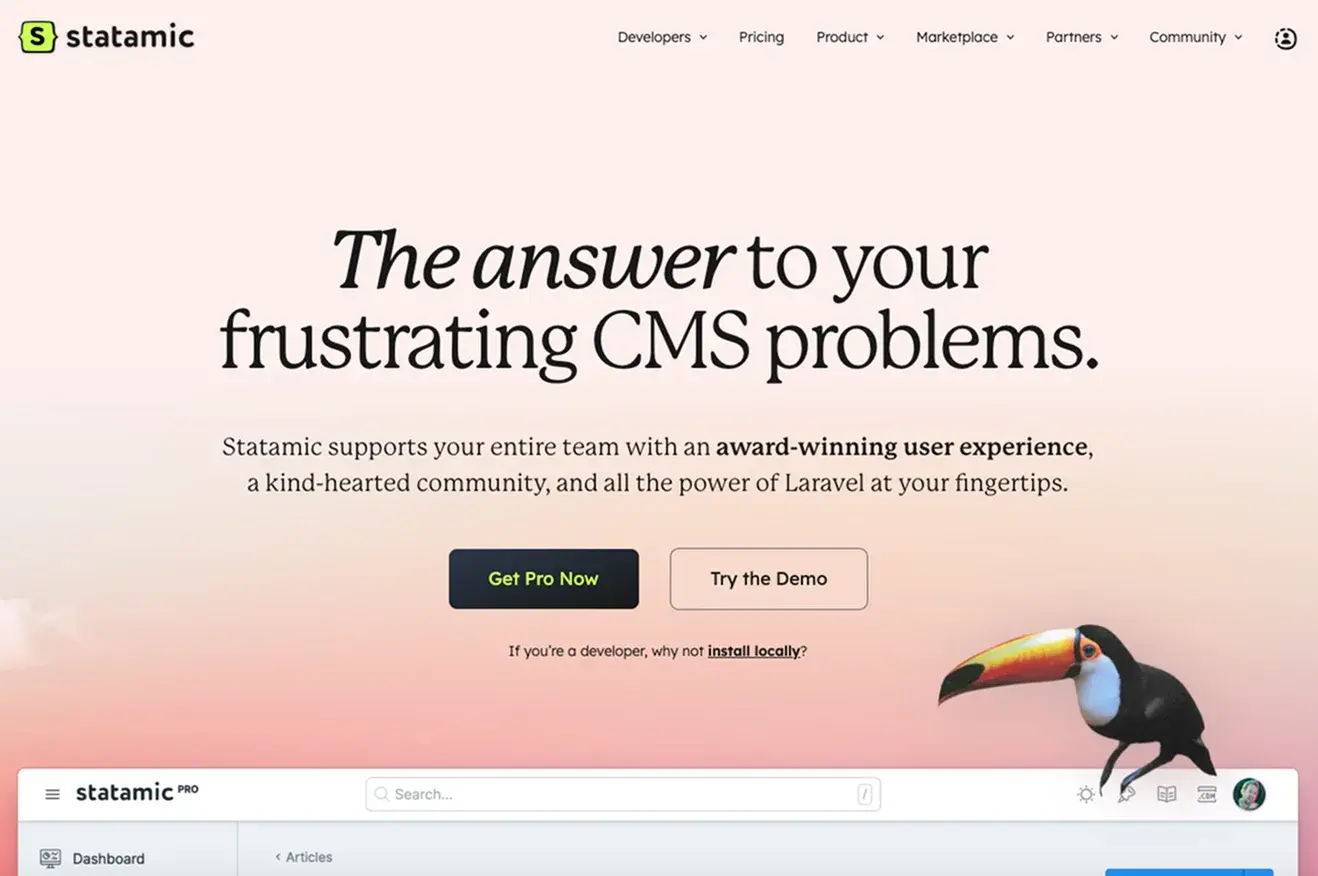
Statamic is a polished Laravel CMS with flat-file or database storage, optional headless APIs, and one of the best editorial control panels in the PHP world. Agencies love it for premium marketing sites where Statamic is the rendering layer or Antlers templates ship quickly.
- Multi-client model: typically one site (or license) per client on Pro—not a built-in multi-project agency dashboard.
- Strength: Laravel-native craftsmanship, developer joy, strong content modeling.
- Tradeoff: license and hosting multiply with client count; headless is optional, not the core story.
Best when each client gets a bespoke Statamic site and you price licenses into the project—not when you want ten APIs from one ops surface.
3. October CMS
October CMS is a mature, extensible Laravel-based CMS with a large plugin marketplace and familiar Laravel conventions. Agencies have shipped countless client sites on October themes and plugins. It fits classic “Laravel CMS company” work: theme + plugins + PHP hosting, less often a unified headless hub for ten separate Next.js frontends.
- Multi-client model: usually separate October instances or custom multi-site patterns you maintain.
- Strength: open source core, plugin ecosystem, comfortable for PHP developers.
- Tradeoff: API-first multi-client isolation is DIY; ops scale with installs.
Strong for plugin-heavy marketing sites on Laravel; weaker as a default agency content API platform for many isolated headless clients.
4. Strapi
Strapi is the headless CMS many agencies compare when clients ask for “something like Contentful but self-hosted.” It is not Laravel—but it shows up in the same evaluations as Laravel CMS for agencies because the buyer cares about API + admin, not PHP specifically.
- Multi-client model: default path is one Strapi application per site (or custom multi-tenancy you own forever).
- Strength: REST/GraphQL, large community, fast for a single Node project.
- Tradeoff: RAM and update cycles multiply; Laravel agencies inherit a second ops culture.
Reasonable for Node-first teams with few clients. At agency scale, compare install math honestly against multisite headless options on one Laravel box.
5. Filament DIY
Filament is not a CMS—it is the fastest way to build a Laravel admin. Agencies sometimes standardize on “Filament + Eloquent + hand-rolled API” as their internal CMS product. That can work for one flagship client or an in-house tool; it rarely stays cheap across ten bespoke codebases.
- Multi-client model: separate apps or heavy custom multi-tenancy.
- Strength: total control, Laravel-native, great for internal ops.
- Tradeoff: you maintain the content API, permissions model, and editor UX—forever.
Before committing the agency to Filament-as-CMS, read Filament CMS: packages vs headless Laravel—the build-vs-buy line is clearer once you price engineer hours.
6. WordPress
WordPress still wins RFPs on familiarity, not architecture. Multisite networks can host many classic sites from one install, but headless WordPress fights plugin weight, REST ergonomics, and a page-centric model agencies then bridge to React frontends. Laravel agencies pick WP when the client demands it—not when they want a standardized Laravel content layer.
- Multi-client model: Multisite or separate installs; headless adds complexity.
- Strength: editor familiarity, plugin marketplace, low friction for marketing owners.
- Tradeoff: not a Laravel stack; security and plugin hygiene at scale.
Cost Reality at 10 Agency Clients
Directional software + hosting shape (excludes your labor). Use for portfolio planning—not vendor quotes.
| Approach | Software | Hosting shape | Annual ballpark |
|---|---|---|---|
| ElmapiCMS multi-project | $74 once | 1 Laravel VPS (~$10–40/mo) | ~$120–480 + license once |
| Statamic Pro × 10 | ~$275/site (typical Pro) | PHP hosting per site | License-heavy + hosting |
| October × 10 instances | Free (open source) | 10× PHP deploys | Hosting × 10 + ops time |
| Strapi × 10 installs | Free (MIT) | 10× Node-friendly VPS | ~$1,200–2,400+ hosting |
| Filament DIY × 10 | Free (your time) | 10× custom apps | Engineering cost dominates |
| WordPress Multisite / mixed | GPL + plugins | Network or many installs | Variable; plugin + care plans |
The line item that kills margins is your hours: ten update cycles and ten on-call surfaces beat one every time—even when the CMS download was free.
Laravel CMS for Agencies: Comparison
| Factor | ElmapiCMS | Statamic | October | Strapi | Filament DIY | WordPress |
|---|---|---|---|---|---|---|
| Many clients, one install | Yes (projects) | Per site* | Per install* | Per install* | Custom | Multisite possible |
| Laravel stack | Yes | Yes | Yes | Node | Yes (build) | PHP (not Laravel) |
| Headless API | REST (core) | Optional | Plugins / custom | REST/GraphQL | You build | REST (WP) |
| Per-client isolation | Built-in | Per deployment | Per deployment | Per install | You design | Per site |
| Software cost shape | $74 once | Per-site license | Open source | MIT | Free + time | GPL + plugins |
| Best for agencies | Multi-client API work | Premium Laravel sites | Plugin CMS sites | Node headless | Internal tools | Client-mandated WP |
*Without custom multi-tenant architecture you build and maintain yourself.
Conclusion: Best Laravel CMS for Agencies?
Laravel agency with many API-first client sites? Standardize on multi-project headless: ElmapiCMS—one self-hosted install, unlimited isolated projects, $74 once.
Fewer clients, premium in-browser Laravel sites? Statamic remains a top-tier Laravel CMS choice—budget licenses per site into your SOW.
Classic theme + plugin Laravel CMS work? October CMS still earns its place in the portfolio.
Comparing Node headless because the client asked? Strapi works—just count installs before you promise margins.
Filament because “we build everything”? Fine for controlled scope; see Filament vs packaged Laravel CMS before ten clients inherit ten custom admins.
Continue with the self-hosted headless CMS overview, the multisite headless comparison, or the broader Laravel CMS comparison.