Hosted CMS usually means faster launch and less ops. The right pick still depends on long-term cost, editorial workflow, API quality, and how painful a migration would be in 18 months.
What is a hosted CMS?
A hosted CMS is a platform where infrastructure, backups, scaling, and uptime are managed for you. Most hosted products are SaaS subscriptions with limits based on users, projects, spaces, API calls, or bandwidth. Self-hosted software can still run on a managed VPS. You own the app and the data.
How we evaluated
We ranked options across editor UX, API flexibility, time to first production release, pricing predictability, enterprise readiness, and migration risk. This is for teams shipping web products, not abstract feature checklists.
Who should choose hosted
- Fast-moving product teams that need to launch without infrastructure overhead.
- Marketing-heavy organizations that depend on visual editing and publishing workflows.
- Teams without dedicated DevOps that prefer managed uptime and security.
1. ElmapiCMS (self-hosted alternative)
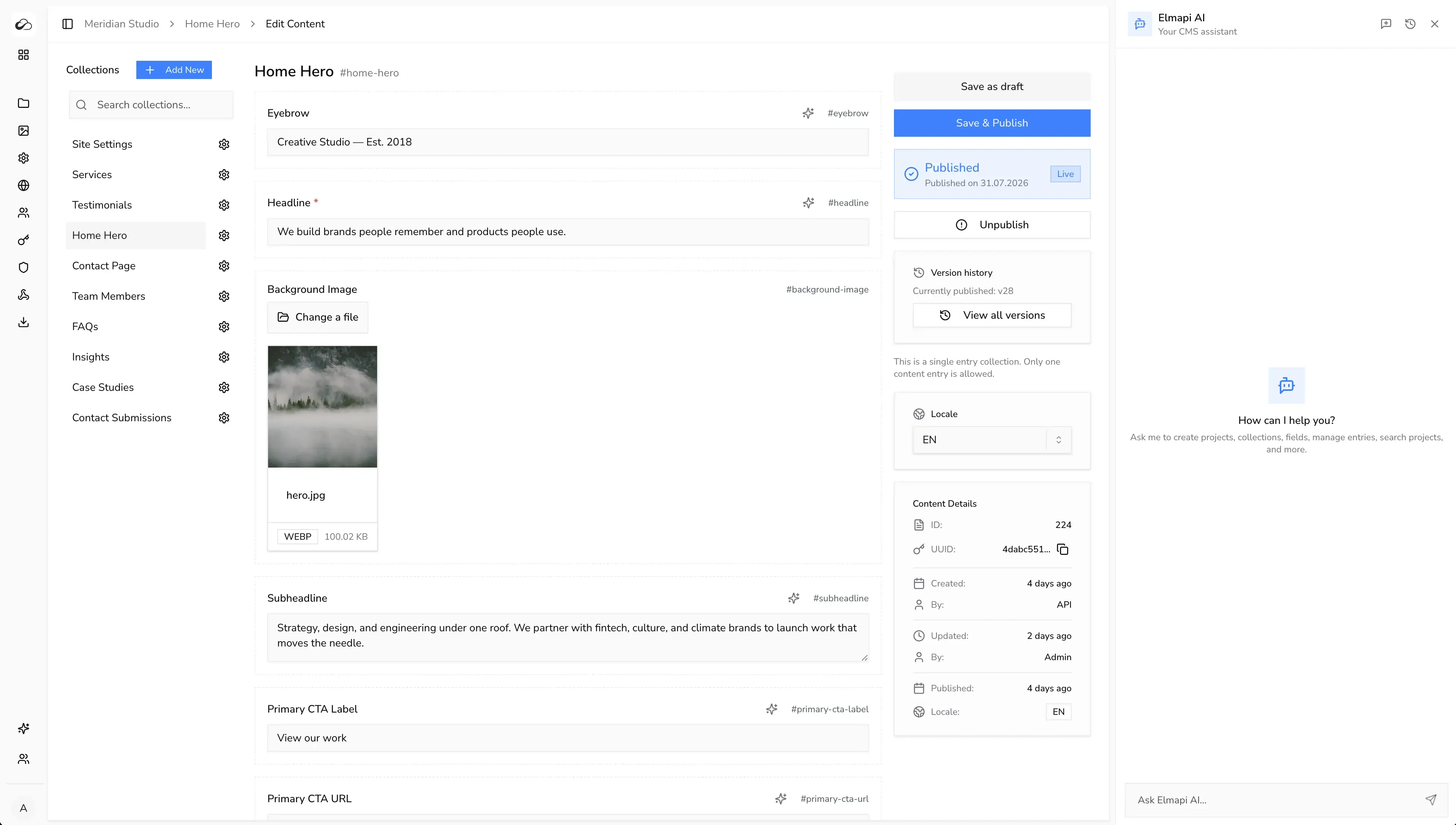
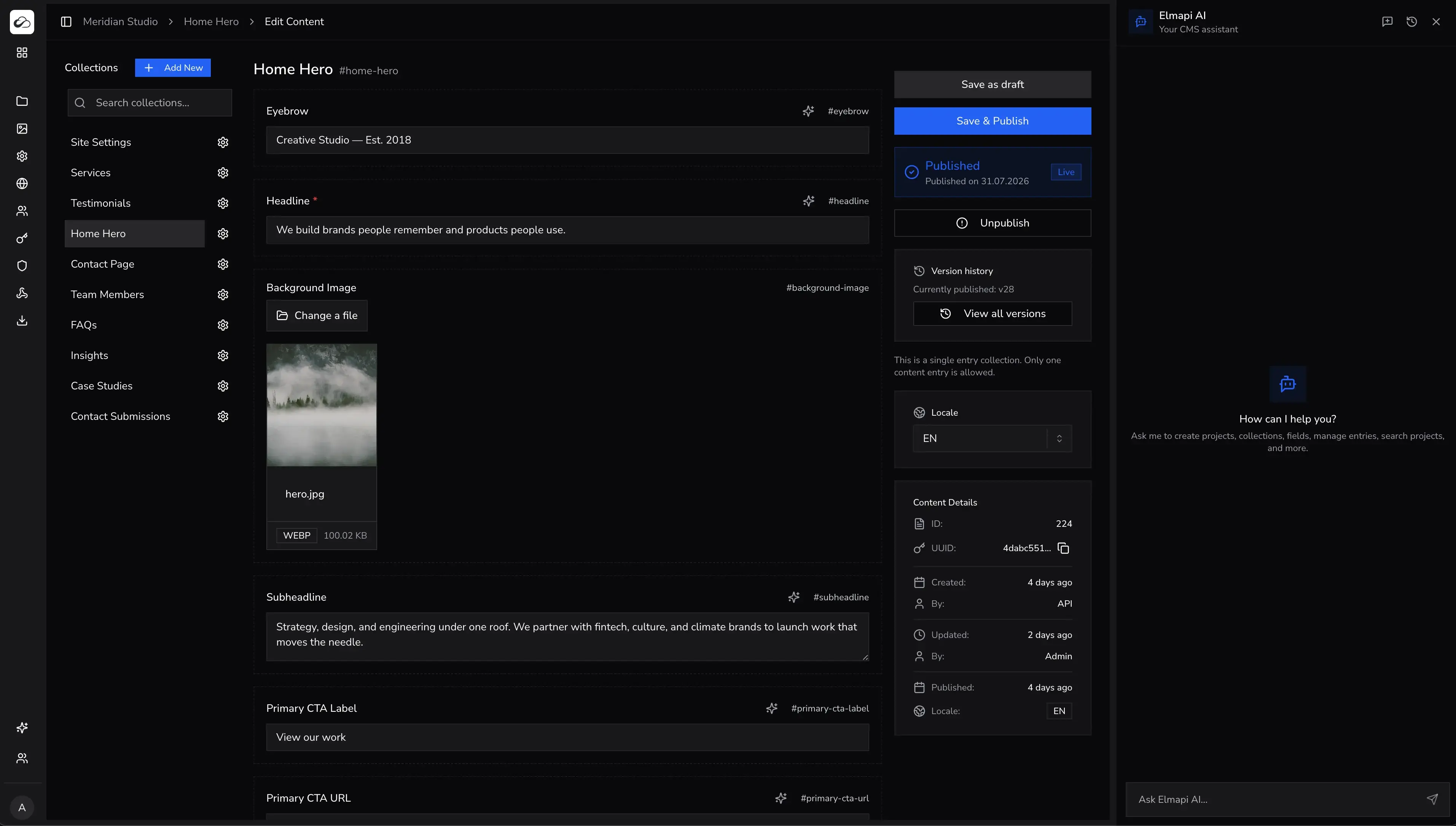
ElmapiCMS is not a hosted SaaS CMS. It belongs at the top of this comparison because many teams evaluating hosted options eventually need tighter control over cost, ownership, and multi-project operations. It is self-hosted software on Laravel 13 and React. It needs PHP 8.4+. You can run it on DigitalOcean, Hetzner, Cloudways, or any PHP host.
One install supports unlimited projects. Each project has its own content and API keys. That is a practical path when SaaS pricing or lock-in becomes limiting.
What ships in 4.0
- Draft and publish, content versioning, and locales
- Asset library with WebP images, crop tools, and optional S3 direct upload
- Built-in AI tools and an official MCP server for Cursor and Claude Code
- Authentication for frontend (signup, sign-in, refresh)
- Frontend templates for Next.js, Nuxt, and Astro
- Webhooks, JS/TS SDK, and project API tokens
Pricing: $74 one-time + hosting. See pricing · Live demo
Best for: agencies and product studios managing multiple properties who still want hosted convenience via a managed VPS.
2. NomaCMS
NomaCMS is a managed, AI-native headless CMS. You get structured content, a REST API, a JavaScript SDK, and AI for writing, translation, and editing. Ship to Next.js, Nuxt, Astro, or other stacks without running your own CMS server. Connect Cursor, Claude Code, or other MCP-compatible tools with the Noma MCP server.
Why consider NomaCMS
- Managed cloud with global CDN for assets and no server ops on your side
- AI assistant, inline field actions, and one-click entry translation
- REST API and SDK with predictable shapes for frontends and automation
- MCP server for AI editors (
npx -y @nomacms/mcp-server) - Project auth, webhooks, locales, and team workspaces on paid plans
Pricing: Plans start at $15 per month after a 7-day free trial. See nomacms.com · Start free trial
Best for: teams that want a hosted CMS with AI-first workflows and delivery infrastructure included, not a self-hosted install.
3. Storyblok
Storyblok is a strong hosted choice for visual editing, content blocks, and marketer-first workflows. It is often selected when editorial teams need to compose pages independently from engineering.
Trade-off: recurring subscription cost grows with usage and team size. Paid plans typically start around $99/month.
4. Sanity
Sanity is strong for structured content systems and collaboration-heavy teams. It offers a robust content platform with flexible schema design and mature APIs.
Trade-off: pricing and architecture can become complex as organizations scale. Growth is about $15/seat/month.
5. Contentful
Contentful remains a reliable enterprise standard with strong governance features, integrations, and a partner ecosystem. Best for larger organizations with strict process requirements.
Trade-off: total cost of ownership can be high for smaller teams.
6. Prismic
Prismic works well for website-focused teams that want a hosted system with manageable complexity. It is popular for marketing sites and landing-page-driven content operations. Paid plans often start around $15/month per repository.
7. Hygraph
Hygraph is strong for GraphQL-first organizations and content federation. It is compelling if your engineering team already standardizes on GraphQL. Growth pricing is often around $199/month.
Comparison table
| Platform | Model | Starting price | Commercial fit | Key trade-off |
|---|---|---|---|---|
| ElmapiCMS | Managed self-hosted | $74 once + hosting | Agencies, multi-brand stacks | You still own deployment decisions |
| NomaCMS | Hosted SaaS | From $15/mo (check site) | Teams wanting managed AI-native CMS | Cloud-only, plan limits apply |
| Storyblok | Hosted SaaS | $99+/mo | Visual editing workflows | Pricing increases with scale |
| Sanity | Hosted SaaS | $15+/seat/mo | Structured content teams | Seat/usage costs can compound |
| Contentful | Hosted SaaS | Lite/Premium | Enterprise governance | Higher price floor for SMB teams |
| Prismic | Hosted SaaS | $15+/mo | Websites and landing pages | Less flexible for complex backend domains |
| Hygraph | Hosted SaaS | $199+/mo | GraphQL-heavy teams | Premium pricing for non-GraphQL teams |
Hosted vs self-hosted
Hosted SaaS wins on launch speed and reduced ops. Self-hosted wins on ownership and long-term economics. A practical middle ground is managed self-hosting: you still get hosted convenience while keeping architecture and cost control.
If you are deciding between SaaS vendors and managed self-hosting, compare this page with our headless CMS pricing guide and best headless CMS comparison.
FAQ
What is the best hosted CMS in 2026?
For ownership and multi-project cost, ElmapiCMS on a managed VPS ($74 once + hosting). For zero-ops AI-native SaaS, NomaCMS. Storyblok and Prismic fit visual editing. Sanity fits collaboration. Contentful fits enterprise process.
Is a hosted CMS better than self-hosted?
Hosted is better when you want zero-ops and a faster launch. Self-hosted is better when you need data control or predictable long-term cost. ElmapiCMS is self-hosted software you can still run on managed infrastructure.
What are the downsides of hosted CMS platforms?
Recurring subscription costs, vendor lock-in, usage-based billing surprises, and less flexibility over infrastructure and compliance.
How to choose
- Cost control, ownership, many sites: ElmapiCMS ($74 once, Laravel 13).
- Managed cloud with AI and MCP, no CMS server: NomaCMS.
- Visual editor for marketing pages: Storyblok or Prismic.
- Studio collaboration: Sanity.
- Enterprise governance: Contentful.
- GraphQL federation: Hygraph.